
Early Years Foundation Stage (EYFS)

This includes Nursery and Reception
The Early Years Foundation Stage
The EYFS is a very important stage in a child’s life as it helps prepare childrens future learning and successes. Children’s early years experiences should be happy, active, exciting, fun and secure; and support their development, care and learning needs. Every child deserves the best possible start in life and the support that enables them to fulfil their potential. Children develop quickly in the early years and a child’s experiences before the age of five will have a major impact on their future life chances.
The EYFS framework explains how and what children will be learning to support their healthy development and provide the foundation children need to make the most of their abilities and talents as they grow up.
Principles
The Early years Foundation Stage is based upon four principles:
• The Unique Child- At Barwick-in-Elmet Church of England Primary School, we recognise that every child is a unique child, who is constantly learning and can be resilient, capable, confident and self-assured. We recognise that children develop in individual ways and at varying rates.
• Positive Relationships- At Barwick-in-Elmet Church of England Primary School, we recognise that children learn to be strong and independent from secure relationships and aim to develop caring, respectful relationships with children and their families.
• Enabling Environments- t Barwick-in-Elmet Church of England Primary School, we recognise that the environment plays a key role in supporting and extending children’s development. Our staff carefully plan the learning environment, planning provision enhancements to further develop and enhance children’s learning experiences.
• Learning and Development- At Barwick-in-Elmet Church of England Primary School, our Nursery and Reception classrooms provide a safe and secure learning environment for the children to freely explore. Our provision areas are set up to encourage independence, allowing children to self-select their resources for learning.
Learning and Development
Children will learn skills, acquire new knowledge and demonstrate their understanding through the
7 areas of learning and development.
Prime Areas:
Communication and language
Physical development
Personal, social and emotional development
Specific Areas:
Literacy
Mathematics
Understanding the world
Expressive arts and design
Characteristics of Effective Learning
Characteristics of Effective Learning are a key element in the EYFS Curriculum.
A child's individual learning characteristic will determine the way they respond to both teaching and learning that takes place at school. The three characteristics are identified as:
- Playing and Exploring
- Active Learning
- Creating and Thinking Critically
The Characteristics of Effective Learning focus on how children learn (the process) rather than what they learn (the outcome).
For more information, follow the links below.
Development Matters
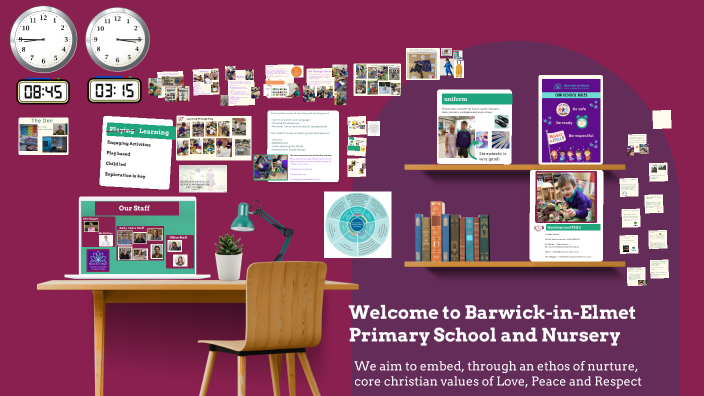
Please use the below link to see our most recent welcome presentation
Any questions please contact Mr Martin - darren.martin@barwickprimary.co.uk

Our Intent (What we do)
At Barwick-in-Elmet Church of England Primary School and Nursery, our Early Years curriculum is rooted in our Christian vision: “We love because He loved us first” (1 John 4:19). This underpins everything we do and is lived out through our whole school values of love, peace, and respect. We believe every child is a unique and precious individual, created by God, and we nurture them so they feel safe, valued, and inspired to learn.
Our curriculum is carefully designed to meet the needs of our pupils and fully embraces the requirements of the Statutory EYFS Framework (2021). We provide equal opportunities for all children within our school community, ensuring no child is left behind. Through rich first-hand experiences, we help children make meaningful connections with real life and the wider world.
We aim to develop confident, aspirational, and respectful learners by offering a sequenced, knowledge-rich curriculum that identifies the core skills and knowledge children need to thrive. High-quality texts are at the heart of our language-rich environment, inspiring curiosity and supporting communication and early literacy.
Our provision is responsive and dynamic: enhancements are shaped by the observed needs, strengths, and interests of each child. This empowers adults to use their professional knowledge of our children and community to adapt learning that is purposeful and engaging.
Through our curriculum, children learn to regulate their emotions, develop independence, care for themselves, and form strong, positive relationships with both peers and adults. Most importantly, they are given the time and space to explore their own interests and develop a love of learning. This foundation ensures that they flourish in their journey into Year One and beyond, ready to live out our values of love, peace, and respect in all they do.
Our Implementation (How we do what we do)
Our Curriculum
At Barwick-in-Elmet Church of England Primary School and Nursery, our EYFS curriculum is carefully designed to meet the needs of all children and aligns with the Statutory EYFS Framework (2021). Over the week, children access discrete lessons in Phonics, Literacy, Maths, and Topics, which are tailored to their age and stage. Alongside these lessons, children engage in continuous and enhanced provision, enabling them to extend and consolidate their learning in meaningful, hands-on ways. Our curriculum is rooted in our Christian vision: “We love because He loved us first” (1 John 4:19), and our whole school values of love, peace, and respect underpin all that we do.
Learning to Read and Write
Phonics is taught in EYFS and KS1 using the Little Wandle programme, a systematic and highly effective approach to early reading and writing. In Nursery, phonics focuses on developing speaking and listening skills through sound games, songs, rhymes, and playful activities. This lays the foundations for early phonics work, helping children to segment and blend sounds, prepare for reading words, and develop oral blending skills.
Literacy lessons follow the Talk 4 Writing approach, developed by Pie Corbett, which combines creativity and structure to support writing development. The approach has three main phases:
Imitation – Children learn a high-quality model text ‘by heart’ using a text map, developing vocabulary and understanding of text structures.
Innovation – Children adapt the model text with adult guidance to make it their own.
Independent Application – Children independently write their own texts using the learned structures.
Visit our Phonics page for more information.
Learning Environment
Our EYFS classrooms and outdoor spaces are thoughtfully designed to inspire curiosity, awe, and wonder. Areas of provision are clearly defined, enabling children to make connections across their learning. Calm, inviting spaces and carefully chosen resources promote focus, exploration, and self-directed learning.
The outdoor area, including our weekly Forest Schools sessions, supports children to develop gross motor skills, resilience, independence, and collaboration. Children lead their own exploration of the forest, gaining life skills such as risk management, problem-solving, and teamwork.
The Role of the Adult
Our skilled and experienced staff play a central role in shaping learning. Adults:
Model accurate vocabulary and grammatical language.
Play alongside children, moving learning forward and identifying next steps.
Follow children’s interests while introducing new challenges.
Support abstract thinking using concrete resources.
Promote high expectations and scaffold learning effectively.
Use professional knowledge of child development to respond to each child’s needs.
Our Partnerships
We value strong partnerships with families, which are central to our children’s success. Staff greet children each morning and afternoon, building trust and positive relationships. We communicate using Class Dojo, daily informal conversations, and social media (Facebook and Instagram), celebrating achievements and sharing updates.
We support families with workshops, stay-and-play sessions, and information about phonics, literacy, and maths. Settling-in sessions and visits to previous pre-school settings ensure smooth transitions for all children starting EYFS.
Our Impact (The result of what we do)
The impact of our Early Years curriculum at Barwick-in-Elmet Church of England Primary School and Nursery is seen in the confident, curious, and well-rounded learners who leave our Nursery and Reception settings. Children are ready to embrace the next stage of their education with a love of learning, strong communication skills, and the personal qualities needed to thrive.
Our knowledge-rich, language-rich curriculum, combined with skilful, dedicated practitioners, ensures that all children make progress from their individual starting points. Children become inquisitive, articulate, and confident learners who feel valued and, in turn, show respect for others. They are able to identify their own strengths and next steps, share their aspirations, and approach learning with curiosity and determination.
Strong personal, social, and emotional development enables children to engage fully in collaborative learning, valuing the contributions of others and communicating effectively across a range of contexts. Children develop independence, resilience, and self-regulation, which supports their ability to learn and explore with confidence.
Our children leave the Early Years fully prepared for the transition to Key Stage One, equipped with the knowledge, skills, and attitudes to succeed academically, socially, and emotionally. They carry forward our Christian values of love, peace, and respect, living out the principle: “We love because He loved us first” (1 John 4:19).
Outcomes:
Children at Barwick-in-Elmet consistently achieve a Good Level of Development (GLD) significantly above national averages, reflecting the strength of our curriculum and the high expectations held for every child.
All children make good or better progress from their starting points, including those with SEND and those eligible for additional funding.
Rigorous assessment and precise next-step planning ensure that every child is appropriately challenged and supported to reach their full potential.
Children demonstrate deep learning across all areas of the EYFS, showing secure foundational knowledge and the characteristics of effective learning that prepare them to flourish in Key Stage One and beyond.
Families and Key Stage One teachers consistently comment on the readiness, enthusiasm, and confidence of children as they transition into Year 1.
Extra Reading for Parents and careers
What to expect from school
Toilet training advice
https://eric.org.uk/potty-training/
Family advice and help
oral health